
“Republicans sure seem to hate democracy. In a multitude of ways, Republicans are subverting the most basic principle of our nation: that the people decide. Like a tin-pot dictatorship, they are using the heavy hand of government power to try to remain in power regardless of the vote of the people.” – The Cap Times, Spencer Black, May 16, 2023 – Opinion | How do Republicans hate democracy? Let me count the ways
“A liberal victory in Wisconsin’s recent high-stakes state Supreme Court election has left former Governor Scott Walker in a foot-stamping, multiplatform fume that targeted the young voters who swung behind the victorious Janet Protasiewicz. “Younger voters may be the behind [sic] the stinging loss for conservatives in WI this week,” he tweeted. “We have to undo years of liberal indoctrination.”” The New Republic, Jason Linkins, April 15, 2023 – It’s Really Quite Simple: Republicans Hate Young People – For all its grousing about “liberal indoctrination,” the GOP has no one to blame but itself for alienating the youth of America.
Recommended Reading
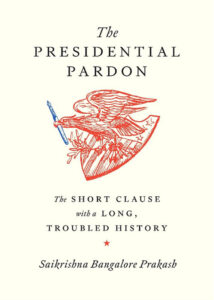
The Presidential Pardon: The Short Clause with a Long, Troubled History
Astonishing, unconstrained, and often unsettling―the presidential pardon is one of the most powerful tools in American government, and this indispensable book is your guide to how it defines the presidency, justice, and politics.
The Constitution’s Pardon Clause grants the president a power unmatched in scope and consequence. In The Presidential Pardon, legal scholar Saikrishna Prakash explores how this brief clause has grown into the most expansive and controversial tool of the modern presidency.
Originally intended as a mechanism of mercy―to temper harsh laws and foster reconciliation―the pardon was once used with solemnity and circumspection. Today, it has evolved into a blunt and potent political instrument. Presidents use it to shield allies, reward supporters, fulfill campaign promises, and make political statements. In January 2025, for instance, the outgoing and incoming presidents issued major pardons―one to protect relatives and allies, the other to deliver on a pledge to his electoral coalition. These actions mark a turning point: the pardon power is no longer a curious exception to politics but increasingly a feature of it. Pardons have become a continuation of politics by other means.
Prakash, a preeminent expert on constitutional law and the executive branch of government, delivers an engaging and accessible analysis of this transformation. The Presidential Pardon brings together little-known history, sharp political insight, and learned constitutional interpretation in a timely examination of executive power. As the partisan exercise of pardon grows more routine, Prakash asks: Can our rule of law survive a presidential power that is checked by no one?