

I grew up during an era where daydreaming was considered loafing or wasting time. The prevailing logic was straightforward: If you were daydreaming, you weren’t working. While reading Brian Clark’s blog on the web site “Lateral Action,” I learned there is sound scientific evidence connecting daydreaming with creativity—people who daydream more are more creative, innovative, and better problem solvers. This puts daydreaming into the respectable category of “productive activity.” According to Dr. Teresa Belton, a researcher at the University of East Anglia in England, “Daydreams involve a more relaxed style of thinking, with people more willing to contemplate ideas that seem silly or far-fetched.” This is what sets the stage for creative behavior. To illustrate, Mr. Clark tells the story of Arthur Fry, a 3M engineer and Presbyterian choir member. Mr. Fry marked songs in his choir book with little pieces of paper which routinely fell out causing him to lose his place. During a Sunday service, Mr. Fry started to daydream. What he needed was a sticky piece of paper that wouldn’t fall out of his choir book. As a result, the Post-it Note was born using a glue product that was going to be discarded by 3M because it didn’t stick well enough. The lesson here is that if you want to make your day more productive, spend part of it daydreaming.
References:
Recommended Reading
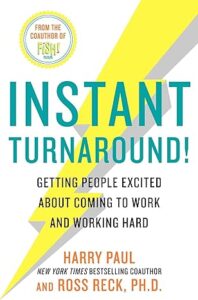
Instant Turnaround!: Getting People Excited About Coming to Work and Working Hard
Transform Your Workplace!
Imagine a company where people are excited about coming to work and giving their best efforts every day. In this innovative and engrossing business parable, Harry Paul and Ross Reck show managers at all levels how they can immediately and easily increase productivity by tapping into the discretionary effort of the people who work for them. Starting from the most basic aspect of business reality—that people intentionally regulate the amount of effort they put into their jobs based upon how they feel they’re being treated—the authors point out that the most important part of the job of every manager, team leader, supervisor, and executive is to treat people in such a way that they become excited about applying all their discretionary effort toward performing their jobs.
At the book’s center is the story of Nancy Kim, a human resources director at a magazine that is struggling with all the problems associated with unhappy employees—low productivity and morale along with high absenteeism and turnover. After she openly challenges the CEO’s new management-by-the-numbers system, she’s charged with turning the situation around immediately. Filled with real-world studies, Instant Turnaround! shows anyone how to turn the workplace into a destination—a place where working hard feels like hardly working because it’s engaging, enjoyable, and fulfilling.
Leave a Reply