

US Constitution – 14th Amendment, Section 1
All persons born or naturalized in the United States, and subject to the jurisdiction thereof, are citizens of the United States and of the State wherein they reside. No State shall make or enforce any law which shall abridge the privileges or immunities of citizens of the United States; nor shall any State deprive any person of life, liberty, or property, without due process of law; nor deny to any person within its jurisdiction the equal protection of the laws. Congress.gov
Chain Migration
Many claim that Chain Migration is what should be illegal. Many wealthy families became citizens of the US because of money. Wikipedia – Chain Migration
Some notable beneficiaries include Melania Trump’ parents. NRP, Scott Neuman, August 10, 2018 – First Lady’s Parents Become U.S. Citizens Thanks To ‘Chain Migration’
Many US States are Suing
Arizona – Kris Mays, Arizona Attorney General, started her lawsuit on January 21, 2025. “No executive order can supersede the U.S. Constitution and over 150 years of settled law. While Trump may want to take this nation back to a time when not all Americans considered equal under the law — we will not allow him to do so.” Arizona Attorney General Press Release, January 21, 2025
Trump Administration Wants to END Birthright Citizenship

“President-elect Donald Trump said in an interview with “Meet the Press” moderator Kristen Welker that “you have no choice” but to deport everyone who is illegally in the United States, including possibly removing the American citizen family members of those deported.” [MSN.com, Allan Smith, December 8, 2024 – Trump aims to end birthright citizenship, says citizens with family here illegally may be deported]
Birthright citizenship is enshrined in the United States Constitution, 14th Amendment, Section 1, “All persons born or naturalized in the United States, and subject to the jurisdiction thereof, are citizens of the United States and of the State wherein they reside.” [The National Archives]
Recommended Reading
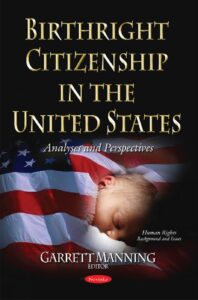
The first clause of the Fourteenth Amendment to the U.S. Constitution, known as the Citizenship Clause, provides that [a]ll persons born or naturalized in the United States, and subject to the jurisdiction thereof, are citizens of the United States and of the State wherein they reside. This generally has been taken to mean that any person born in the United States automatically gains U.S. citizenship, regardless of the citizenship or immigration status of the persons parents, with limited exceptions such as children born to recognized foreign diplomats. The current rule is often called birthright citizenship. However, driven in part by concerns about unauthorized immigration, some have questioned this understanding of the Citizenship Clause, and in particular the meaning of subject to the jurisdiction [of the United States]. This book traces the history of birthright citizenship under U.S. law and discusses some of the legislation in recent Congresses intended to alter it.
Recommended Reading
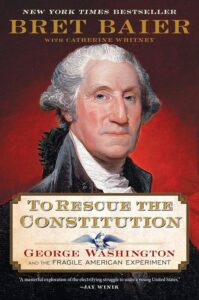
A sweeping narrative ranging from the unsettled early American frontier and the battlefields of the Revolution to the history-making clashes within Philadelphia’s Independence Hall, Bret Baier’s To Rescue the Constitution dramatically illuminates the life of George Washington, the Founder who did more than perhaps any other individual to secure the future of the United States.
George Washington rescued the nation three times: first by leading the Continental Army to victory in the Revolutionary War, second by presiding over the Constitutional Convention that set the blueprint for the United States and ushering the Constitution through a fractious ratification process, and third by leading the nation as its first president. There is no doubt that the struggling new nation needed to be rescued—and that Washington was the only American who could bring them together.
After the victorious War of Independence, when a spirit of unity and patriotism might have been expected, instead the nation fractured. The states were no more than a loosely knit and contentious confederation, with no strong central union. It was an urgent matter that led to the calling of a Constitutional Convention to meet in Philadelphia during the summer of 1787.
Setting aside his plan to retire to Mount Vernon, Washington agreed to be a delegate at Philadelphia. There he was unanimously elected president of the convention. After successfully bringing the Constitution into being, Washington then sacrificed any hope of returning to private life by accepting the unanimous election to be the nation’s first president. Washington was not known for brilliant oratory or prose, but his quiet, steady leadership gave life to the Constitution by showing how it should be enacted.
In this vivid and moving portrait of America’s early struggles, Baier captures the critical moments when Washington’s leadership brought the nation from the brink of collapse. Baier exposes an early America that is grittier and far more divided than is often portrayed—one we can see reflected in today’s conflicts.
Leave a Reply