

The American Civil Liberties Union
The ACLU has evolved in the years since from this small group of idealists into the nation’s premier defender of the rights enshrined in the U.S. Constitution. With more than 1.1 million members, 500 staff attorneys, thousands of volunteer attorneys, and offices throughout the nation, the ACLU of today continues to fight government abuse and to vigorously defend individual freedoms including speech and religion, a woman’s right to choose, the right to due process, citizens’ rights to privacy and much more. The ACLU stands up for these rights even when the cause is unpopular, and sometimes when nobody else will. While not always in agreement with us on every issue, Americans have come to count on the ACLU for its unyielding dedication to principle. The ACLU has become so ingrained in American society that it is hard to imagine an America without it.
Recommended Reading
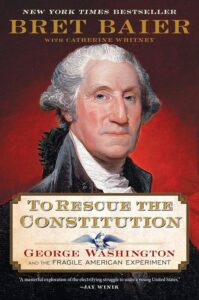
A sweeping narrative ranging from the unsettled early American frontier and the battlefields of the Revolution to the history-making clashes within Philadelphia’s Independence Hall, Bret Baier’s To Rescue the Constitution dramatically illuminates the life of George Washington, the Founder who did more than perhaps any other individual to secure the future of the United States.
George Washington rescued the nation three times: first by leading the Continental Army to victory in the Revolutionary War, second by presiding over the Constitutional Convention that set the blueprint for the United States and ushering the Constitution through a fractious ratification process, and third by leading the nation as its first president. There is no doubt that the struggling new nation needed to be rescued—and that Washington was the only American who could bring them together.
After the victorious War of Independence, when a spirit of unity and patriotism might have been expected, instead the nation fractured. The states were no more than a loosely knit and contentious confederation, with no strong central union. It was an urgent matter that led to the calling of a Constitutional Convention to meet in Philadelphia during the summer of 1787.
Setting aside his plan to retire to Mount Vernon, Washington agreed to be a delegate at Philadelphia. There he was unanimously elected president of the convention. After successfully bringing the Constitution into being, Washington then sacrificed any hope of returning to private life by accepting the unanimous election to be the nation’s first president. Washington was not known for brilliant oratory or prose, but his quiet, steady leadership gave life to the Constitution by showing how it should be enacted.
In this vivid and moving portrait of America’s early struggles, Baier captures the critical moments when Washington’s leadership brought the nation from the brink of collapse. Baier exposes an early America that is grittier and far more divided than is often portrayed—one we can see reflected in today’s conflicts.
Leave a Reply